 Write a comment
In the days of the Fianna legends the men of Ulster would have sallied forth through the Pass to wage battle with the forces of Leinster, and many of the battles of the Táin Bó Cúailnge, or Cattle Raid of Cooley were fought here between Cúchulainn and the armies of Queen Medb. The name Moyry comes from the Irish Maigh-Rí or “Plain of the King”, likely in reference to its proximity to Emain Macha, the seat of the High Kings of Ulster.

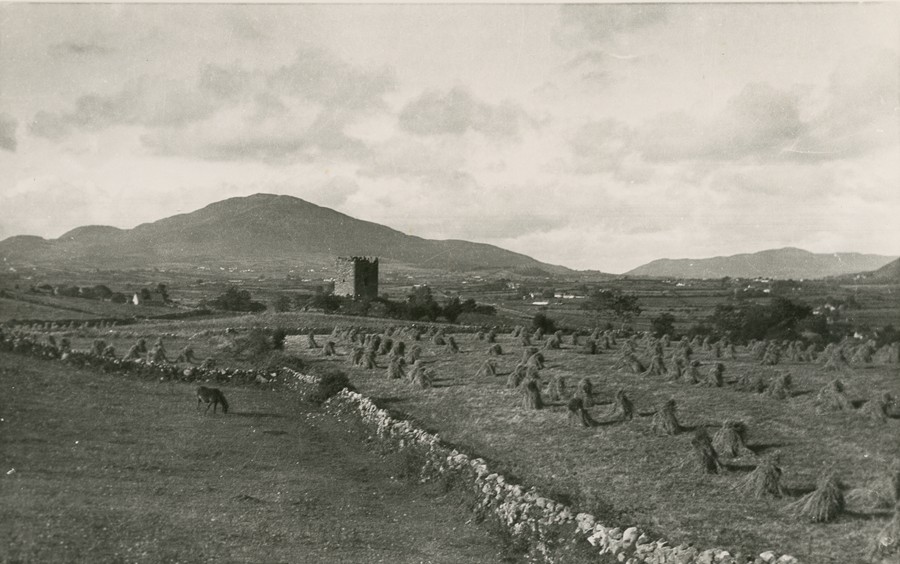
Under the shadow of Slieve Gullion and perched on an outcrop overlooking the pass lies the ruins of Moyry Castle. Built in 1601 during the Nine Years’ War by Lord Mountjoy, Queen Elizabeth’s Lord Deputy of Ireland, it was a campaign fort designed to house a small battalion to defend the pass against the forces of Hugh O’Neill, Earl of Tyrone.
During the year leading up to its construction Mountjoy’s army was garrisoned at Dundalk and would foray through the pass to encounter O’Neill’s men where they had fortified the area. In May, and again in September of 1600, Mountjoy’s men attempted to advance through the Pass, encountering heavy losses at the hands of the Irish who had firmly entrenched themselves in the wooded countryside. Finally, in October, after gathering his strength in Dundalk, a last great push was made by the English forces, and they seized control of the Pass, clearing away the forest and setting up a heavily guarded fort.
In May of 1601, Mountjoy decamped his army from Dundalk and marched on Newry, leaving instructions for a stone keep to be erected in Moyry Pass, and thus work began on Moyry Castle. The building was completed within a month, and control of the garrison there was given to Captain Anthony Smith.
The castle is rectangular and unusual in that it was built with rounded corners. It had a very basic structure, consisting of three floors reached by ladders as there was no staircase. The living quarters had fireplaces and windows, and the wall-walk had an exposed latrine tower.
The ground floor and second floor contained numerous gun-loops, and a machicolation or “drop-hole” above the door meant anyone brave or foolhardy enough to approach the castle entrance would be met with a rain of rocks or other missiles. The castle was once surrounded by a stone bawn wall. However, little remains of this today.
A short distance from the castle is Kilnasaggart Inscribed Stone, one of the oldest inscribed stones in Ireland. The stone dates from the 8th century and was dedicated to Ternhoc son of Ceran Bic. Excavations in the 1960s revealed that it sat on the site of an early Christian graveyard.
The Museum is currently offering free tours of the exhibition galleries on Wednesdays and Thursdays at 2.00 pm. These must be booked in advance by calling our Education Officer at 0330 137 4422.
Newry and Mourne Museum is open Tuesday – Saturday 10.00 am – 4.30 pm. Please call 0330 137 4422 or email museum@nmandd.org for further information.
Please visit our website at www.visitmournemountains.co.uk